
Taking a cat on a train in the UK
Updated
The rail network is one of the few places you can take a cat without asking anyone’s permission first. What it asks in return is specific, and it is written down.
What the rules actually say
One document sits behind all of this: the National Rail Conditions of Travel, the contract between you and the train companies that takes effect when you buy a ticket. Animals are Condition 24, and the version in force is valid from 30 July 2026.
dogs or other small domestic animals you may take free of charge, unless your train company sets conditions of its own
maximum size for the basket or pet carrier; an animal too large for one may not be conveyed by train at all
Condition 24.3 decides what you carry the cat in: a “fully enclosed basket or pet carrier designed for this purpose”, under those dimensions, and “large enough to allow the animal to stand and lie down in comfort”. That last clause is a test on the cat rather than on the bag: what settles it is your cat’s length and its height at the shoulder. Our measuring method is the one that also decides a cabin flight.
Two more clauses catch people out. Condition 24.2: no animal on a seat, in any circumstances, and none in buffet or restaurant cars other than assistance dogs. Condition 24.4: animals other than dogs must not be taken out of their carriers — not for a cuddle, not at a long stop, not on the platform. And 24.1 lets each train company add conditions of its own, so the last step before booking is the conditions page of the company you are travelling with. Sleeper cabins are separate again; 24.5 sends you to the operator.
The part that happens a week earlier
Nothing on a platform can rescue a cat that has never been in the bag before. A station is louder than a vet’s waiting room and full of moving strangers at ankle height; a cat meeting that from inside an object it also met this morning absorbs two shocks at once.
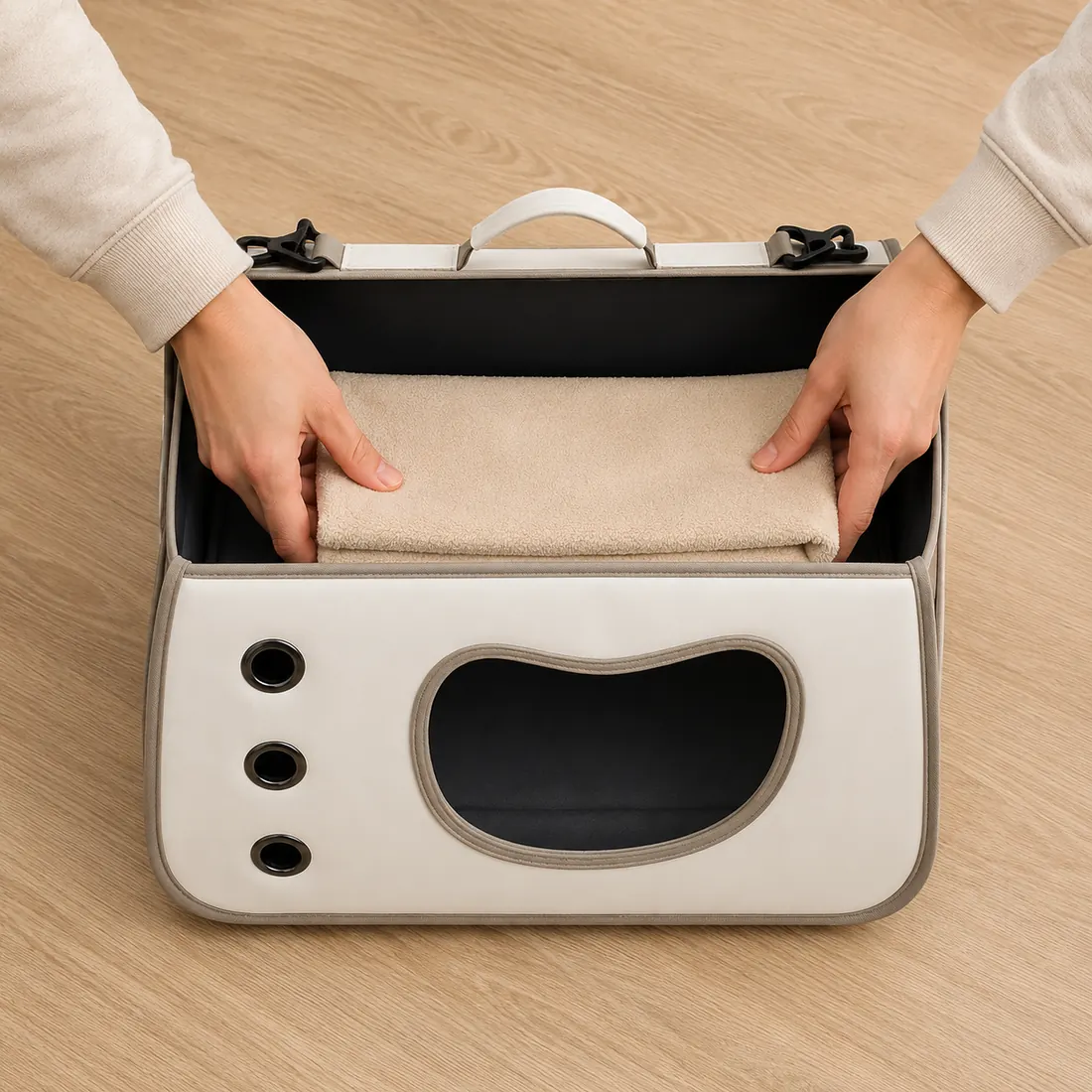
So the carrier lives open in the room the cat sleeps in for two or three weeks beforehand, until it stops being an event; the full sequence is in our guide to getting a cat into a carrier. Then reserve a seat where the service allows it, because ninety minutes standing in a vestibule with a carrier in one hand is a different journey.
Getting through the station
Carry the bag against your body rather than swinging from one hand. A carrier held at arm’s length sways, and sway is the one thing a cat cannot brace against; across the chest or on the back it moves with you instead, and stays above knee height, clear of wheeled luggage and dogs.
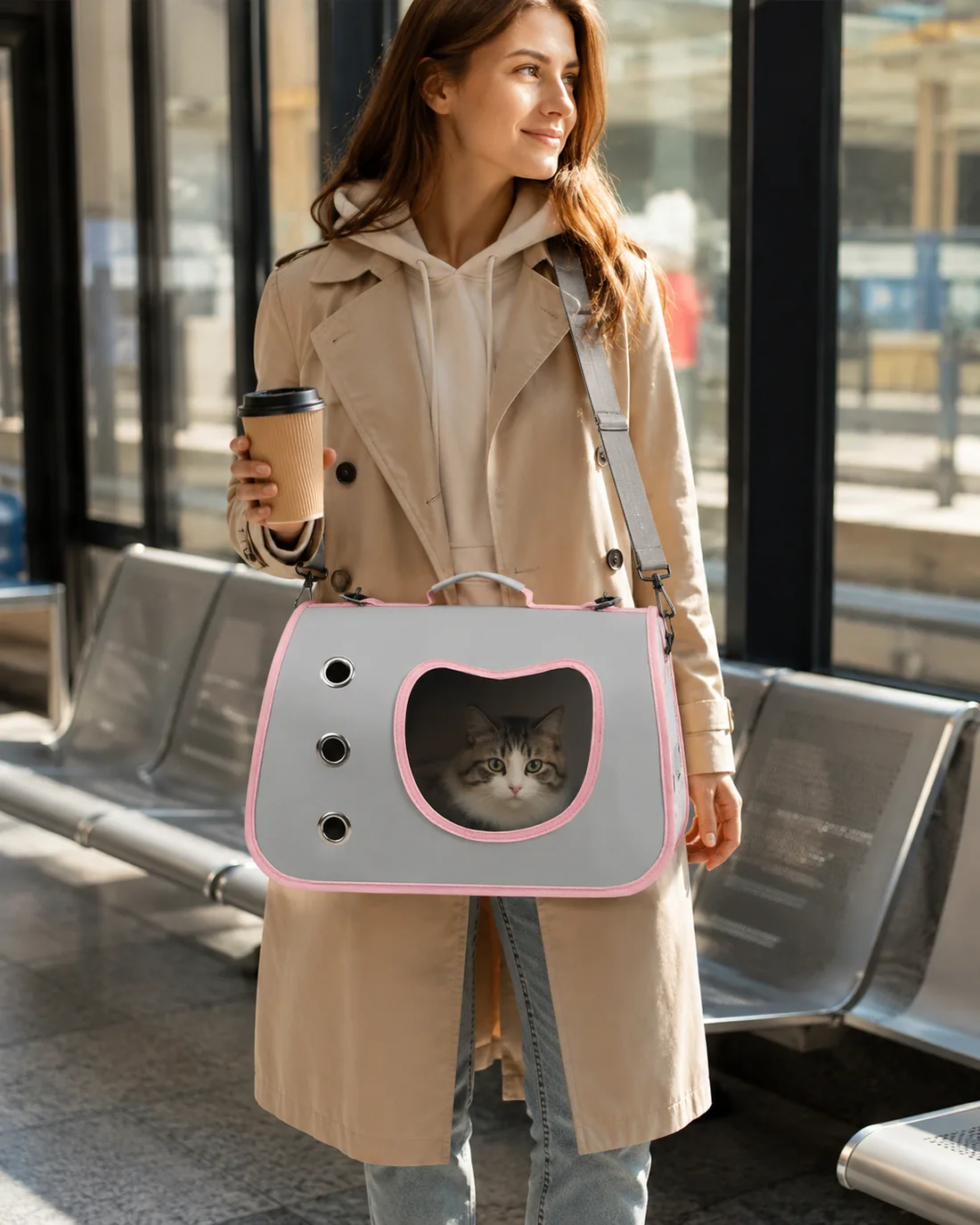
At the barrier, take the wide gate: staff will wave you through it, and it saves turning a carrier sideways while the paddles close on it. On the platform, stand back from the edge and off the tactile strip — an arriving train is the loudest thing of the day and it comes from behind.
A light cloth over three sides, front panel left clear, cuts the visual noise down to one direction while the mesh keeps air moving. Covering the whole bag is the version to avoid: it closes off the airflow the panels exist to provide.
Where the carrier goes on board
Not on the seat. That is Condition 24.2 rather than etiquette, and it holds in first class as well as standard. What is left is the floor at your feet, your lap, or the shelf under a table — and the floor between your feet is usually best: stable, the coolest air in the carriage, and below the eye line of everyone walking past.
Keep it off the overhead rack and out of the luggage stack by the doors: both put the cat where you cannot see it, the rack is warm, and the stack is where cases get pulled out at every stop. On a table shelf, keep a hand on it — British rolling stock brakes harder than most people expect.
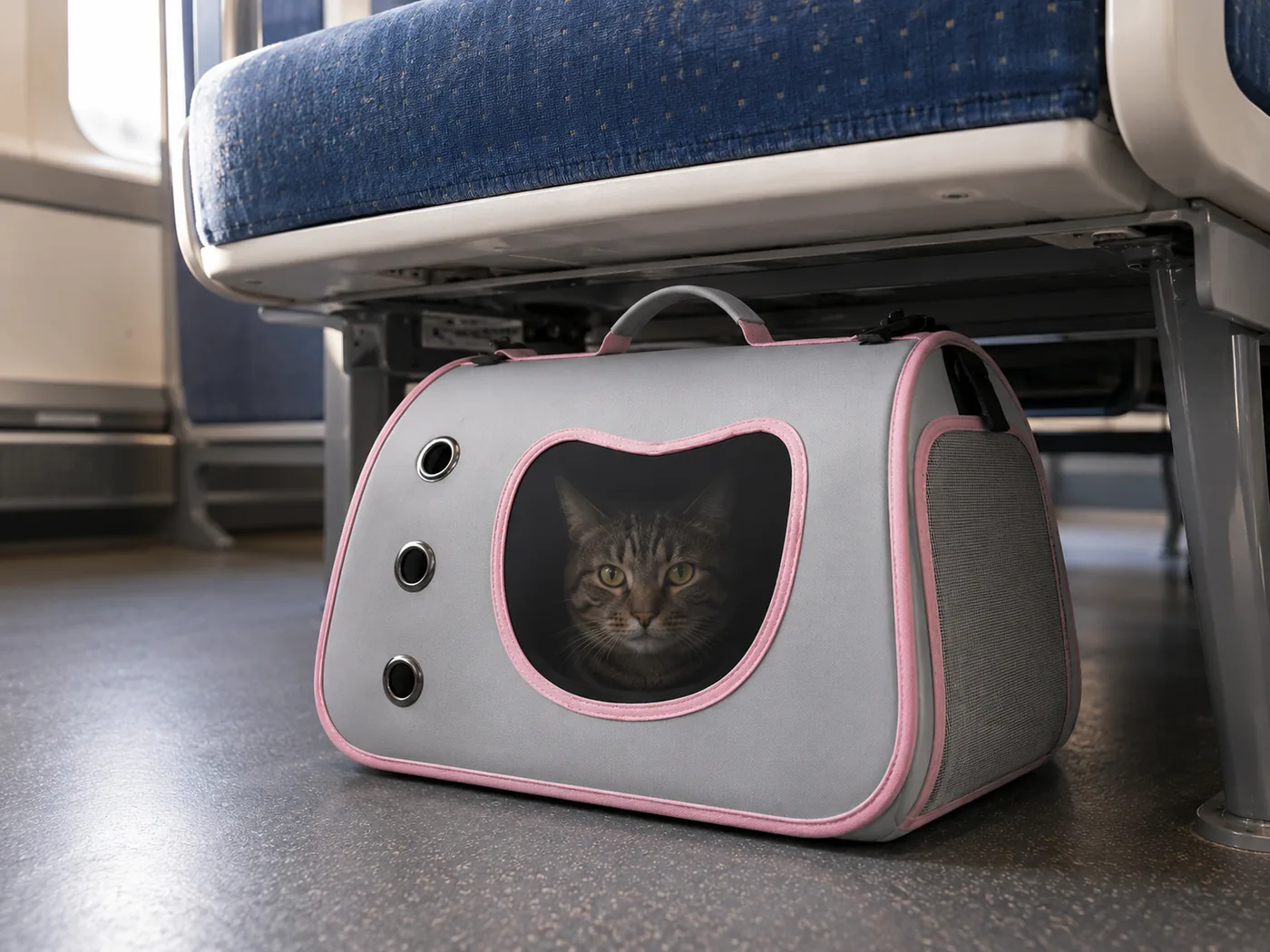
Air is the thing people underestimate on a train, because a train feels cool while you are standing in it. A full carriage in summer is a different place down at floor level inside a closed bag, and mesh on a single face leaves it to chance which way you set the bag down. Panels on more than one face take that decision away: turn the largest outward, into the aisle.
Changing trains, and the London part
A change is the riskiest twenty minutes of the day, and the risk is not the cat — it is you, moving fast with one hand occupied. Give a connection more time than you would alone: the eight-minute change that works when you travel light is the one that ends in a run.
If the connection goes through London you cross onto a second network with its own published rules. Transport for London asks that cats and small animals travel in a secure, well-ventilated carrier suitable for their size, suggests covering it to reduce stress, allows no pets on seats, and recommends the wide gates. The one that surprises people: pets must not walk on escalators, so lifts and stairs wherever possible. With a cat in a carrier that is moot, but it decides your route, and interchange lifts are often at the far end of a platform.
what a pet pays on TfL public transport services when it travels with someone holding a valid ticket or a validated card
Two further pieces of the same guidance are decided at the booking stage rather than on a platform: travel at quieter times where the timetable allows, and avoid travelling in extreme heat.
Water, food and the litter question
Start from Condition 24.4, because it settles the question people ask first: the cat does not come out. Not at a long stop, not in a quiet carriage, not on a four-hour run. A litter tray therefore means a small tray inside the carrier, or none at all — and for most journeys it means none, for the same reason it does on a long drive: a cat somewhere unfamiliar usually holds on, and most will not use a tray in a moving vehicle anyway. A wipe-clean base with an absorbent pad under the blanket handles the exception.
Water works the same way. Offer it, expect it to be refused, and do not press. A collapsible bowl through the opened front panel, bag on your lap and both hands on it, is enough. Skip the meal before you leave: a near-empty stomach travels better.
Vocalising for the first twenty to thirty minutes is ordinary and it usually settles. Drooling, repeated swallowing, open-mouth breathing or vomiting is not. If your cat is severely anxious about travel, or a previous journey went badly, that is a conversation with your vet before you book: they know the animal, and any decision about medication is theirs to make.
Arriving
The journey is not over at the barrier. Whatever the cat has just absorbed, it lands somewhere that smells of nobody. Set the carrier down in one closed room that already has the litter tray, the water and a hiding place in it, open the front panel, and leave the cat to come out in its own time. A cat that walks out has ended the journey on its own terms; a cat that is lifted out has had one more thing done to it.
Give that room a few days before the rest of the house — this is the part of the 3-3-3 rule that applies to a single journey as much as to a rehoming. Leave the carrier in there, open, for the whole settling period: it is now the one object in the building the cat has met before.
Which of the two suits a train
For rail, three things decide it: whether your hands are free, whether the bag breathes on more than one side, and whether it fits between your feet rather than in the luggage stack. Both of ours clear Condition 24.3 with room to spare.
The bubble backpack is 42 × 34 × 27 cm and rides on your back, which is what makes a busy concourse and a flight of station stairs straightforward: both hands stay free for tickets, doors and a suitcase. Its clear front window lets the cat see out of a bag standing on the floor, where a mesh panel would face a seat frame. The soft shoulder carrier is 40 × 26 × 22 cm, worn across the body, and it is the narrower of the two: it goes down an aisle without turning sideways, tucks under a table seat, and folds flat between trips.
Both are fully enclosed, both let a cat stand and lie down at the sizes we publish, and both ventilate on more than one face. Our comparison of the two constructions goes through the rest, and the measurements sit side by side on the home page to hold against your own cat before you book.