
Travelling with a cat by car
Updated
Most of what goes wrong on a car journey is decided before the engine starts.
Where the carrier goes
A carrier on the passenger seat is a carrier that moves. Under braking it slides forward; on a roundabout it tips. Neither is dramatic on its own, but a cat that has been thrown against the side of a bag once will fight the bag for weeks afterwards, and you will pay for that on every trip after this one.
The rear seat is the sensible answer. It is flatter, the bench gives the carrier a wider footprint than a contoured front seat, and the seatbelt gives you something to secure it with. Thread the belt through the carrier's strap or handle so the bag cannot slide along the bench, and set it so the mesh or window panel faces into the cabin rather than into the seat back. A cat that can see you is measurably quieter than one that can hear you and not find you.
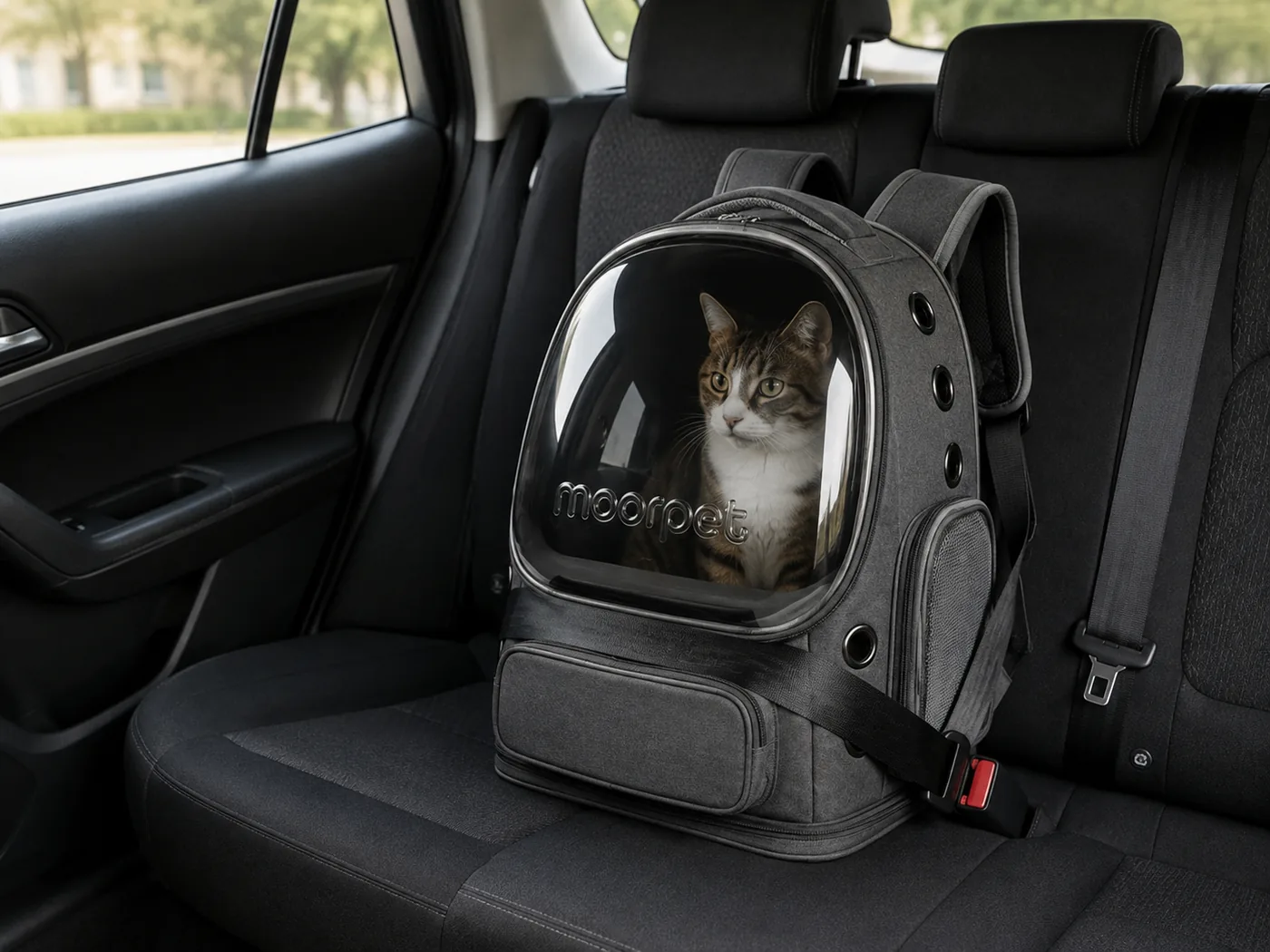
The footwell behind the front seats is the other workable spot, and on a small carrier it is arguably the best one: it is the most stable place in the car and the carrier cannot go anywhere. It is darker, which suits some cats and not others. What you are choosing between is stability and visibility, and cats differ on which they want.
| Placement | Stability | What it costs you |
|---|---|---|
| Rear seat, belted | Good | Nothing, if the belt actually passes through a strap |
| Rear footwell | Best | The cat cannot see you; harder to reach at a stop |
| Front passenger seat | Poor | Contoured seat, airbag, and the cat is at windscreen level in sun |
| Boot | Varies | Worst ventilation in the car, and out of sight for the whole drive |
Breaking up a long drive
Two to three hours is a reasonable leg. Cats do not need a comfort break on the schedule a dog does — most will not use a litter tray in a moving car and many will not use one at a service station either — so the stop is less about the cat's bladder and more about temperature, water and a few minutes of quiet with the engine off.
Offer water at every stop and expect it to be refused. A cat that is stressed will not drink, and pushing it makes the next hour worse rather than better. Put the bowl down, let it sit for a minute, take it away. If the drive is long enough that this matters genuinely — more than five or six hours — that is a conversation worth having with your vet before you go, not a problem to solve at a motorway services.
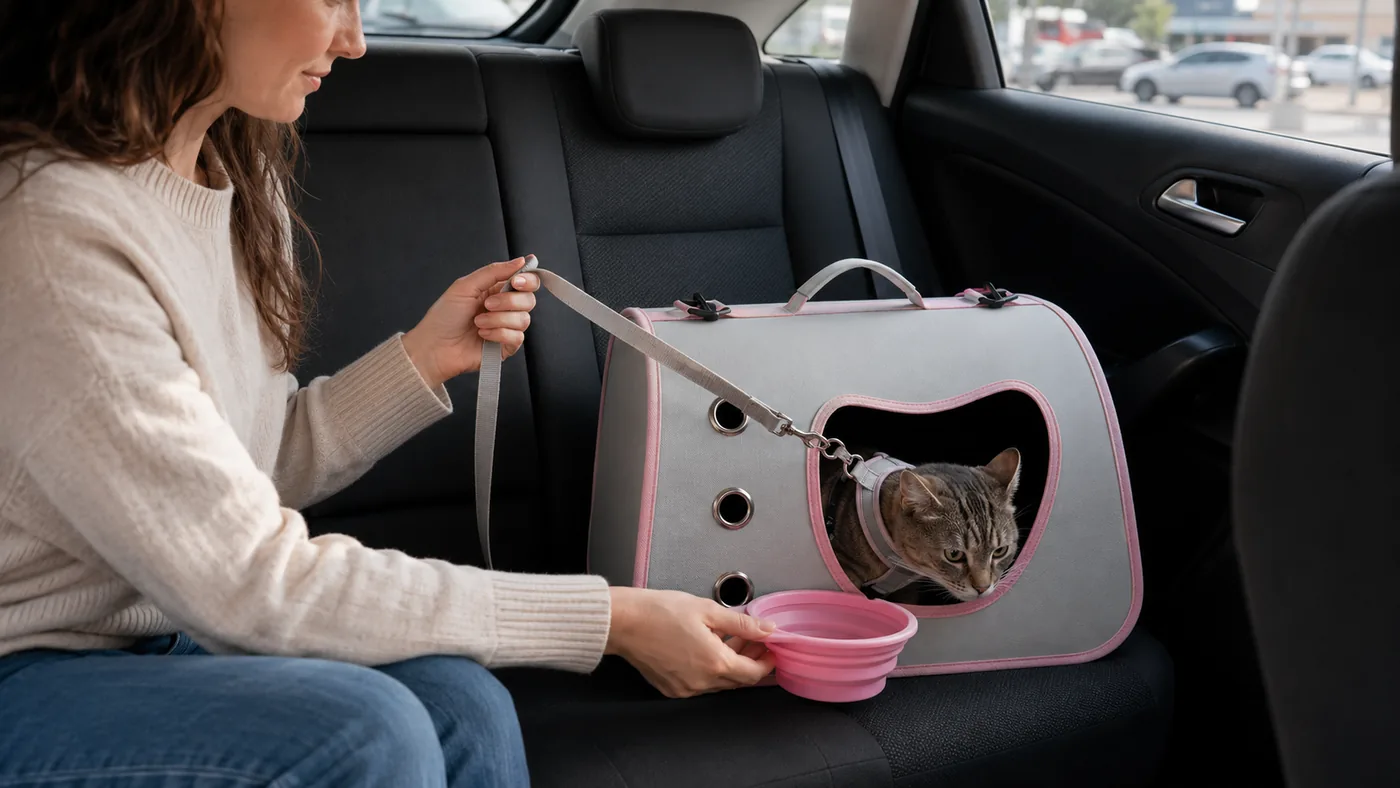
One thing worth doing that almost nobody does: open the door on the shaded side of the car, not the side you happen to be parked on. Five minutes with the sun coming through an open door undoes the point of the stop.
Keep the carrier closed at every stop. A service station car park is the single most likely place on the whole journey to lose a cat, and a cat that bolts there is gone into moving traffic. If you want the cat out of the bag at all, it comes out inside the closed car with the doors shut, on a harness, or it does not come out.
The cat that cries the whole way
Constant vocalising on a car journey is normal, it is not usually pain, and it almost always settles within twenty to thirty minutes if the cat is going to settle at all. What it means is that the cat is being carried somewhere it did not choose, in a container it associates with the vet, in a moving box that smells wrong. All three of those are addressable, and only one of them is about the car.
The container is the part you control cheaply. A carrier that lives open in the living room for three weeks before the trip stops being a vet-shaped object and starts being furniture. That is the whole method, and it is written up in full in our guide on getting a cat into a carrier. It is the single highest-return thing you can do before a drive, and it costs nothing.
Two things that help on the day: a worn t-shirt or the cat's own blanket in the base, so the bag smells like home rather than like detergent, and covering three sides of the carrier with a light cloth while leaving the front open. A cat that can see out of one side and is enclosed on the others behaves like a cat in a den. A cat that can see out of all four behaves like a cat on a shelf in a moving room.
If the crying comes with drooling, repeated swallowing or vomiting, that is motion sickness rather than protest, and it is a conversation with a vet — there are prescription options and they are not something to buy off a shelf on our say-so.
Heat is the part that actually hurts
Everything above is comfort. This section is the one that matters, and the figures are more extreme than most people expect — they come from a study that parked a dark saloon on sixteen clear days and logged the interior temperature continuously for an hour.
the average RISE in interior temperature over 60 minutes on a clear day, measured across ambient temperatures from 22 °C to 36 °C (a 40 °F rise)
of that rise happens in the first 30 minutes — the danger is front-loaded, not gradual
difference made by leaving the windows cracked open 1.5 inches: 3.4 °F per 5 minutes closed against 3.1 °F per 5 minutes open
Read the second and third of those together, because that is where the practical advice lives. The rise is front-loaded, so “I was only five minutes” is not the reassurance it sounds like — at an average of 3.2 °F per five-minute interval, five minutes is already a measurable change. And cracking the windows, which is the thing almost everybody does instead of not leaving the animal at all, did not slow the rise in any meaningful way. The study was run on infants left in cars; the physics is the same for a cat, and a cat in a closed fabric carrier inside that car has less air around it, not more.
The rule that follows is short. The cat does not stay in a parked car. Not while you pay for fuel, not while you use the toilet at a services, not with the windows down. If the journey requires a stop where somebody has to leave the vehicle, somebody stays with the animal, or the animal comes with you.
Air conditioning while you are driving is the easy half, and the vents matter more than the setting: a carrier on the rear bench in direct sun through a side window is warm even in a cool car. Park to keep the sun off that side, or move the carrier across.
Which of the two suits a car
For a car specifically, the shape that matters is the base. A carrier with a rigid, flat base sits level on a bench and does not fold around the cat under braking; a bag that sags puts the cat's weight on its own legs for the whole journey.
Our soft shoulder carrier is 40 × 26 × 22 cm with a padded flat base, and belts easily through its shoulder strap — it is the one we would take on a drive that ends at an airport, because it is also the one sized against cabin envelopes. The bubble backpack is 42 × 34 × 27 cm and stands up on its own, which makes it the steadier of the two in a footwell, and its front window means the cat can see the cabin from a spot where a mesh panel would face carpet.
Both are soft-sided, and that is a real trade-off worth naming rather than glossing: a rigid plastic carrier is more crash-resistant than any fabric bag, and if crash protection is your first criterion, that is the category to look at. What a soft carrier buys you is that the cat will actually get into it, which is the difference between a journey that happens and a journey that starts forty minutes late. Our comparison of hard and soft carriers goes through the whole trade in detail, and the two carriers are side by side on the home page if you want the dimensions next to each other.