
Is flying too stressful for a cat?
Updated
It depends almost entirely on one thing, and it is not the bag.
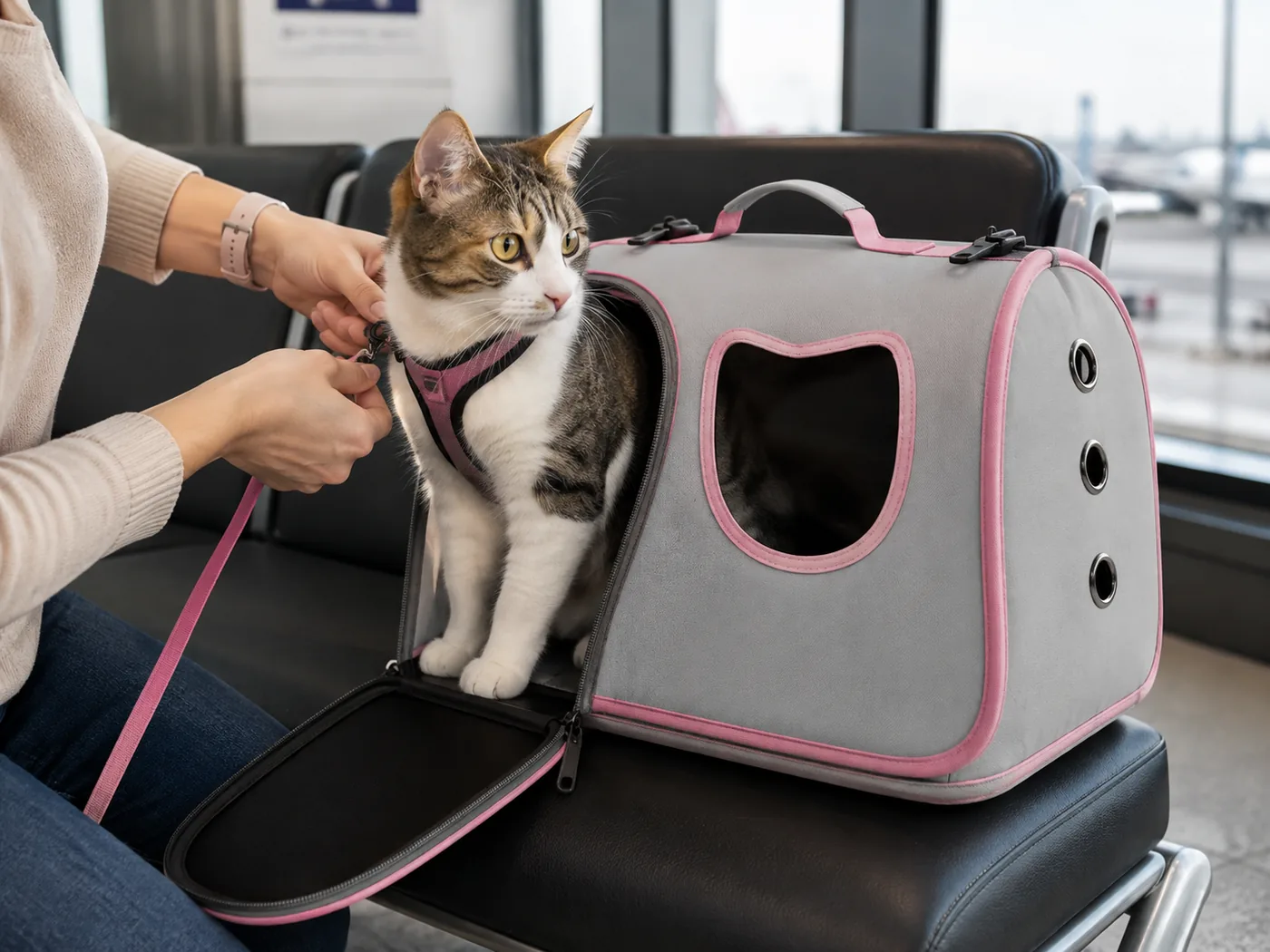
Cabin and hold are two different questions
Most articles about flying with a cat quietly answer only the first one. A cat in the cabin stays in the pressurised, temperature-controlled part of the aircraft, at your feet, within reach and within sight. A cat in the hold travels in a pressurised compartment as well — that part is often misunderstood — but alone, in the dark, through the loading process, and often through a longer total journey than the flight time suggests.
Which one you are dealing with is frequently not your decision. Across the four countries we ship to, three major airlines do not take cats in the cabin at all: British Airways, Qantas and Air New Zealand carry them as freight only. Two do — Virgin Australia and Air Canada — and each publishes a maximum carrier size. If you are flying with one of the first three, no purchase changes the answer, and the conversation is with the airline rather than with a shop. The published envelopes, airline by airline, are here.
What actually stresses a cat in transit
It is tempting to picture the flight itself as the ordeal. For most cats it is not the worst part. Cats are territorial animals with a strong preference for the familiar, and what upsets them is the sequence: being caught, being confined without warning, being carried, unfamiliar noise, unfamiliar smells, and a total absence of anywhere to hide. A cruise at altitude, oddly, is one of the quieter stretches of the day.
That matters because it tells you where the effort belongs. The stressful moments cluster at the start — the cupboard opening, the carrier appearing, the grab — and at the security check, where the cat has to come out of the bag in a busy hall. Both of those are rehearsable at home, weeks earlier, for free.
The other reliable stressor is heat, not altitude. Airport aprons, queues and unairconditioned transfers are where animals get into trouble, which is why most carriers embargo hold travel for pets during summer heat on certain routes. If your airline offers you a seasonal restriction, it is not bureaucracy; it is the actual risk.
What the published work supports
There is less research on cats in aircraft than anyone would like. What there is good evidence for is the thing that happens before the airport. A team at the University of Veterinary Medicine in Vienna compared cats that had been familiarised with their carrier in short, unpressured sessions against cats that had not, before a car journey and a veterinary consultation. The familiarised cats showed fewer signs of stress in transit, and their examinations took less time. (Pratsch et al., Applied Animal Behaviour Science, 2018.)
That result is about carriers and cars, not cabins, and we are not going to stretch it further than it goes. But the mechanism it describes — a carrier that has stopped predicting anything is a carrier the cat will enter — is the same one that applies at five in the morning on the way to a terminal. The three-week method is written up here.
On medication, there is a published trial: a single dose of gabapentin given before a journey reduced signs of stress in cats during transport and veterinary examination (van Haaften et al., Journal of the American Veterinary Medical Association, 2017). You will see it discussed elsewhere, so the source is named here. Anything given before a flight is a conversation with your own vet, who knows the animal — not a purchase, and not something to read off a product page. Sedation in particular is treated very differently for cabin and hold travel, and several carriers refuse sedated animals outright.
When the answer is not to fly

Sometimes it is. A short holiday is not usually worth a hold journey for a cat that has never travelled, and the alternative is genuinely good: cats do better left at home with a visitor coming in than most owners expect, because the thing they are attached to is the territory as much as the person. Elderly cats, cats with heart or respiratory conditions, and flat-faced breeds are all in the category where the question for a vet is whether the journey should happen at all.
A permanent move is a different calculation, and there the question stops being whether to fly and becomes how to do it least badly. That usually means the shortest routing rather than the cheapest, a direct flight over a connection, and travelling outside the hottest part of the year where the route allows it.
If you are flying anyway
Start the carrier work three weeks out, not the night before — that single change does more than everything else on this list combined. Put in a blanket that already smells of home rather than a new one. Feed nothing in the three hours before departure, but leave water available until you go.
Rehearse the security check: the cat comes out of the carrier and is carried through the scanner while the bag goes on the belt, so a well-fitted harness is not optional, and a cat that has never worn one should not meet it for the first time in a queue. Keep the carrier at your feet rather than on a seat once you are through, and resist opening it in the cabin — a frightened cat in an aircraft aisle is a much larger problem than a frightened cat in a bag.
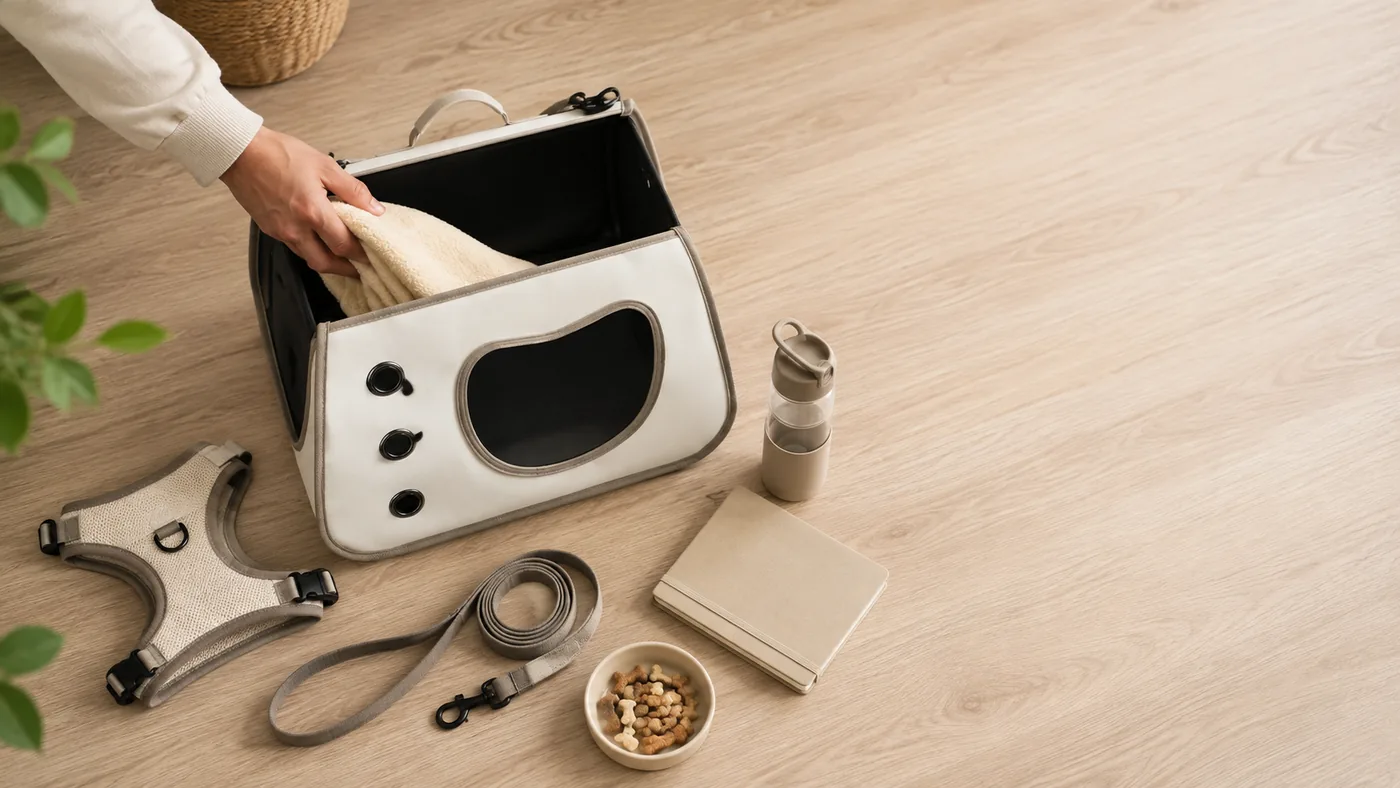
Book the cat on when you book yourself. Cabin places for animals are capped per flight — Virgin Australia allows four — and they are gone long before the seats are.
The part the carrier actually plays
A carrier cannot make a cat enjoy an airport. What it can do is narrow: fit the published envelope so nobody argues with you at the gate, hold its shape so the cat is not squashed when the bag is set down, ventilate on more than one side, and open in a way that lets you lower the cat in rather than push it through. Our shoulder carrier is 40 × 26 × 22 cm, which sits inside Virgin Australia’s limit and inside Air Canada’s on regional aircraft — though it is 2 cm too tall for Air Canada’s mainline jets, which publish a separate, smaller size. It folds flat between trips — which matters more than it sounds, because a carrier that lives folded under a bed comes out often enough to stop being an event.
One thing we will not print on it is “airline approved”. No airline approves a model of bag. It publishes a maximum size, and any bag inside that size is acceptable on that airline, that route, that aircraft. Two numbers beat a badge, and they stay true when a policy changes.